I live in France, and its future concerns me. When its ten-year yield crosses 5%, my main question is whether political leaders will have the courage to take the decisions the country needs, even when they are unpopular.
My concern is less about the demonstrations themselves than about what I believe they reveal: our difficulty accepting an effort today to improve tomorrow. I feel that public debate too often rewards protecting the immediate present while postponing long-term decisions. That is my perspective, rather than a description of what every French person believes.
France can still borrow. The more difficult question is what it may have to give up to keep borrowing on acceptable terms.
The French ten-year yield’s move through 5% is a warning, rather than an automatic insolvency threshold. The economic issue is the rising cost of postponing an adjustment, financing a deficit and replacing old debt.
MITUXA View: the first consequence is likely to be a loss of fiscal flexibility, before any potential funding crisis. Households and businesses can feel the effects even while government auctions continue to function.
1. What the numbers actually say
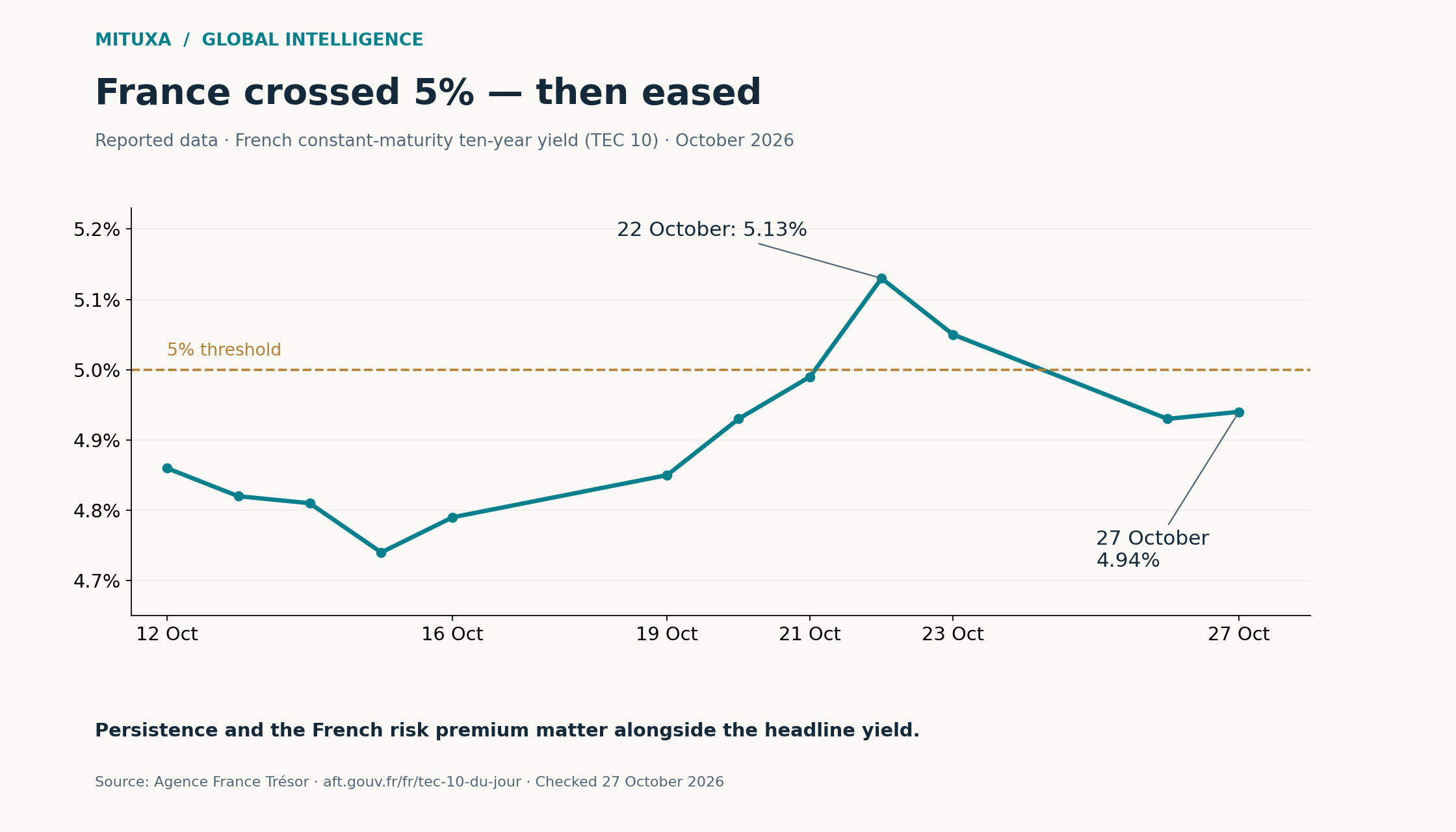
Reported. Reuters recorded the benchmark ten-year yield reaching 5.002% intraday on 21 October, its highest since 2002. The French debt agency’s constant-maturity TEC 10 series shows 4.99% on 21 October, 5.13% on 22 October, 5.05% on 23 October, 4.93% on 26 October and 4.94% on 27 October. These are different references and observation times, not one interchangeable series. [1][2]
The accurate statement is therefore that the yield crossed 5%, rather than that it necessarily remains above it when this article is published.
A secondary-market yield is not the coupon on every outstanding bond, or the average interest rate on the entire public debt stock. A fixed-rate bond’s price can fall and its market yield rise without changing its contractual coupon.
2. Refinancing creates a slow-moving squeeze
Reported. At the end of September, marketable central-government debt had an average remaining life of eight years and 158 days. This delays transmission; it does not eliminate refinancing needs. [2]
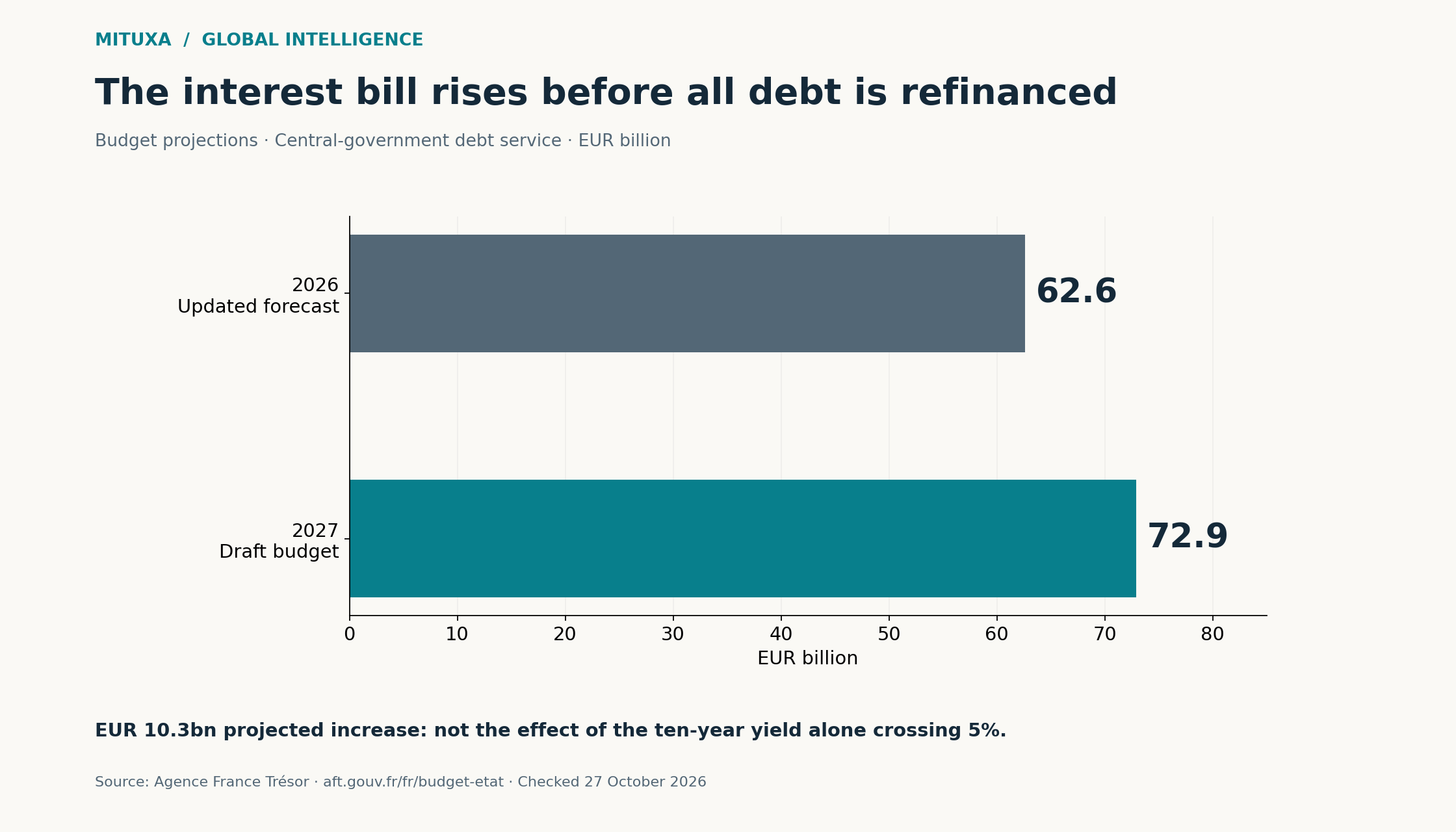
Budget proposal, not an observed outcome. The AFT presents €340 billion of medium- and long-term issuance, net of buybacks, for 2027. That includes refinancing, rather than representing €340 billion of additional debt. Budgetary central-government debt service is projected at €72.9 billion, against €62.6 billion for 2026. These figures do not cover interest expenditure across all levels of government. [3]
Multiplying the whole public debt stock by 5% would therefore give a misleading estimate of next year’s bill. Maturities, short-term rates, inflation-linked debt and the terms of individual issues matter.
The fiscal council reports a government simulation: a permanent 100-basis-point rise across all maturities, starting in January 2027, would add €3.4 billion in interest in year one and €8.1 billion in year two. This is not the estimated effect of the ten-year yield alone crossing 5%. [4]
3. The vulnerability is the starting position
Reported. INSEE puts Maastricht public debt at €3,595.5 billion, or 119% of GDP, in the second quarter of 2026. That includes more than central-government debt. [5]
Official scenario. The government debt report published on 6 October projects 121.7% of GDP in 2027. Its planned fiscal improvement would still leave the deficit above the level needed to stabilise the ratio immediately. This is a conditional official projection, not an observed result or an independently established consensus. [6]
MITUXA View. Higher rates are particularly uncomfortable when a country must refinance maturities, fund a deficit and protect growth simultaneously. Interest costs can rise before reforms deliver their full economic benefits.
A 5% ten-year yield alone does not establish insolvency. The effective average interest rate, nominal GDP growth, the primary budget balance and political capacity to adjust are more informative together.
4. Public choices become harder
MITUXA View — transmission mechanisms, not enacted policies. A persistently higher interest bill pushes towards some combination of higher revenue, slower spending growth, reduced investment or more borrowing. Each shifts the burden rather than making it disappear.
Tax increases can weigh on consumption and investment. Spending restraint affects beneficiaries, public services and suppliers. Cutting investment can improve the near-term balance at the expense of future growth. More borrowing can defer the adjustment while increasing exposure to rates.
The adverse loop is higher financing costs, a difficult adjustment, weaker growth, disappointing revenue and further pressure to tighten. This is a risk scenario, not an inevitable sequence.
Political courage: deciding beyond the next election
My perspective — MITUXA View. What concerns me most is not that reforms encounter opposition. It is the prospect that fear of opposition becomes a permanent reason to avoid decisions.
I feel that too many political leaders prioritise their immediate electoral position over explaining the choices needed for the next decade. Protecting every item of spending, benefit and exception can sound reassuring individually. Collectively, they must be financed. Debt postpones that confrontation; it does not remove it.
I am also concerned about our collective time horizon. In my view, French debate too often focuses on what a measure takes away today and too little on what inaction may cost tomorrow. That does not mean every French person rejects reform or that every proposed reform is sound. My criticism concerns the decision-making horizon, rather than each citizen.
Political courage is not indiscriminate cutting. It means deciding what to protect, what to reform and what to stop financing — and explaining those choices with verifiable results.
This requires examining spending effectiveness, programmes that no longer fulfil their purpose and obstacles to economic activity. It also requires protecting investments whose benefits arrive later: skills, education, infrastructure and productive capacity. An announced savings figure alone does not demonstrate that a reform improves the country.
Street events must be described accurately: Reuters reports largely peaceful rallies on 24 October followed by clashes including in Paris and Marseille; AP records demands concerning education and living costs. [9][10] These facts do not establish every protester’s or policymaker’s motivations. My political criticism is separate from that reporting.
My fear is that, by postponing choices, France may eventually have to accept choices imposed by its funding constraints. This is not inevitable. Credible policy would set out trade-offs, timing, expected effects and the distribution of the burden, rather than promising to protect the present without a cost to the future.
For investors, repeated postponement creates uncertainty about taxes, policy continuity and investment. Assessments should follow measures actually adopted and implemented, rather than treat my judgement of political courage as a directly measurable variable.
5. Businesses: the next refinancing matters
MITUXA View. French companies do not automatically borrow at the OAT yield. Their costs depend on currency, maturity, collateral, credit quality and banking conditions. Sovereign stress can nevertheless transmit through confidence and funding markets.
The most exposed businesses combine high debt, near-term maturities, reliance on external finance and weak pricing power. Property, some infrastructure businesses and activities tied to public procurement deserve scrutiny. Smaller domestic companies can face both tighter credit and weaker demand.
International, cash-generative groups may be more resilient without being immune to taxes or higher required equity returns. Headquarters location is insufficient: investors need to map revenue, debt and commitments.
The practical research questions are which debts mature over the next two or three years, whether rates are fixed or floating, what hedges exist, and how much cash remains after investment and dividends.
6. Banks and insurers: no simple winner
MITUXA View. Higher yields can improve income on new assets. They can also raise deposit and wholesale funding costs, reduce the market value of existing bonds and weaken borrowers’ credit quality.
Mark-to-market losses do not always become immediate profit-and-loss charges. Accounting classification, hedging, prudential rules and any need to sell assets determine the impact. The relevant exposure is the balance sheet, rather than a sector label.
Insurers can gradually reinvest at better yields, but competing savings products may encourage withdrawals and liquidity needs. We make no institution-specific solvency claim without examining its disclosures.
7. Housing: existing borrowers and new buyers differ
Reported. The Banque de France highlights the prevalence of fixed-rate housing loans, which protects existing borrowers from an automatic repricing of their contracts. [7]
MITUXA View. The pressure falls mainly on new buyers, new lending and transaction volumes. Mortgage pricing also depends on bank funding, hedging and competition. A 5% OAT does not automatically imply a 5% mortgage.
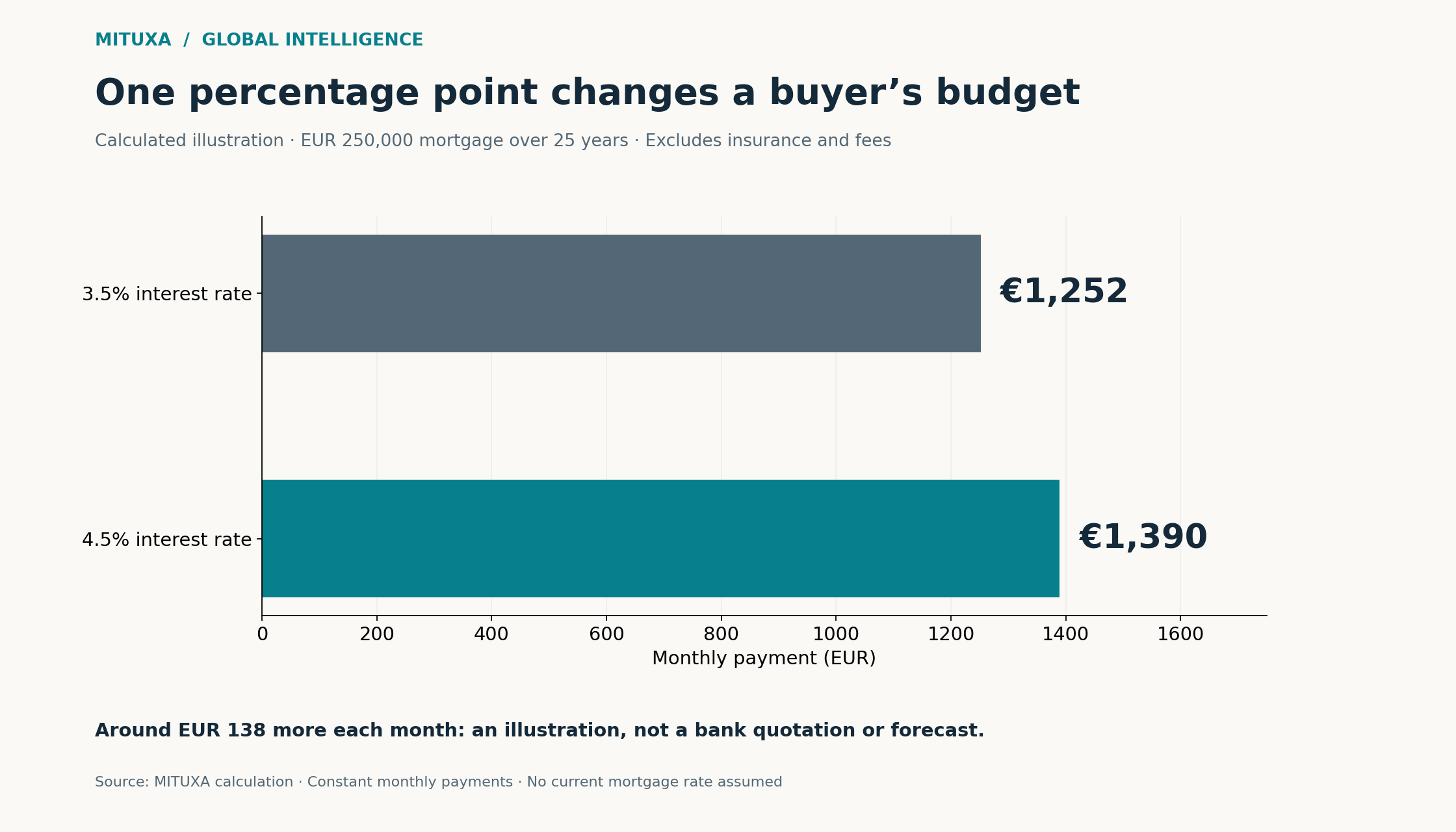
Calculated illustration, not a loan quotation. A €250,000 amortising loan over 25 years costs approximately €1,252 a month at 3.5%, versus €1,390 at 4.5%, excluding insurance and fees. The extra €138 can reduce purchasing capacity or delay a transaction; it does not predict a uniform fall in house prices.
8. Asset values must compete with the price of money
MITUXA View. Higher bond yields can increase the return required to justify an unchanged asset price. Businesses valued mainly on distant profits, indebted companies and slow-growing income streams may become more vulnerable to repricing.
Newly purchased bonds can offer higher yields while existing bonds lose market value. Direct bonds, bond funds and French euro-denominated insurance funds have different mechanics. An advertised yield is not a guaranteed real return after inflation and tax; selling a bond before maturity exposes the holder to price changes.
Nor does sovereign stress establish that French equities are bargains. A margin of safety requires verified business-level valuations and normalised earnings, rather than a country discount in isolation.
9. The ECB is a backstop with conditions
Institutional framework. The Transmission Protection Instrument addresses unwarranted, disorderly market dynamics threatening monetary transmission. Activation is discretionary and takes account of debt sustainability and fiscal policies, among other criteria. There is no automatic 5% trigger. [8]
MITUXA View. Protecting monetary transmission would not replace a credible fiscal path, or guarantee a particular borrowing rate to a member state.
10. Three paths, without invented probabilities
Normalisation: fiscal credibility and lower inflation pressure reduce the risk premium. Yields ease, although refinancing already completed at higher costs continues to affect the budget.
Persistent pressure: market access remains available, but expensive. The central risk becomes a gradual squeeze on growth, investment and public flexibility.
Escalating stress: a widening French premium, deteriorating auction conditions and spillovers to banks and private borrowers would make the situation more serious. One session above 5% does not establish this scenario.
Absolute yields and the spread against comparable German debt must be assessed together. A global bond sell-off and a France-specific loss of confidence require different explanations.
The investment conclusion
The visible event is a yield crossing 5%. The less visible event is its gradual transmission through budgets, credit and investment decisions.
MITUXA View: the deeper cost may be the diversion of capital and public choices towards financing the past. A government spending more on interest has less flexibility to invest, absorb a recession or respond to an emergency.
This thesis would weaken with a sustained fall in the French premium, a credible stabilisation of debt and improving growth. Repeated fiscal misses and broader credit tightening would strengthen it.
We will watch the TEC 10, comparable OAT–Bund spreads, auctions, the maturity calendar, primary balances, interest expenditure, bank credit and corporate refinancing. Temporary relief is not a fiscal solution; a psychological threshold is not a catastrophe forecast.
Which reform should finally be pursued, even if its benefits only emerged after the next election?
For information and education only. This is not personalised investment advice or a recommendation to buy or sell. MITUXA scenarios are conditional analysis, not certain forecasts. Questions and counterarguments: questions@mituxa.com.
Sources and scope
Edition dated 27 October 2026. The TEC 10 observation and AFT budget figures were refreshed on 27 October; other source checks were completed on 26 October. Reported figures, official projections, calculated illustrations and MITUXA interpretations are distinguished throughout.
- Reuters, Amanda Cooper, 21 October 2026, intraday benchmark observation: Source
- Agence France Trésor, TEC 10, observations through 27 October 2026: ; debt maturity at 30 September: Source 1 · Source 2
- AFT, Budget de l’État, draft 2027 financing programme and updated 2026 figures, consulted 27 October 2026: Source
- Haut Conseil des finances publiques, opinion HCFP-2026-5, 25 September 2026, paragraph 116 and figure 20, government parallel-rate-shock simulation: (indexed official text available; direct page returned an access error during verification). Source
- INSEE, 29 September 2026, public debt at Q2 2026: Source
- Direction générale du Trésor, 6 October 2026, government public-debt report for 2027: Source
- Banque de France, Le modèle français de financement de l’acquisition de la résidence principale — 2026: ; interest-rate transmission explainer: Source 1 · Source 2
- ECB, 21 July 2022, original TPI framework: . Cited as the instrument’s published design, not evidence of present activation or France’s present eligibility. Source
- Reuters, Juliette Jabkhiro, Yann Tessier et Crispian Balmer, 24 October 2026, updated 25 October: Source
- Associated Press, Thomas Adamson, John Leicester and Tom Nouvian, 24 October 2026: Source